Compostable, recyclable, or reusable? What each organic coffee pod claim means after you brew the cup, and five picks that are honest about it.
More than a quarter of Americans who brew coffee at home use a pod machine. The Daily Coffee News reported that 28 percent of people who drank coffee at home used a single-cup brewer, second only to drip machines. That’s a lot of pods, and most of them end up in the trash.
The industry’s answer has been to change the packaging. Most of the large brands now make an environmental claim on the box. Compostable. Recyclable. Plastic-free. Each claim comes with a catch: the box leaves out what your local recycling or composting service will take. You’ll also want to know whether the coffee inside was chosen as carefully as the packaging. A pod can be perfectly compostable and still make a bad cup of coffee.
What the eco claims mean once the cup is brewed
Start with recyclable, the most common claim. In September 2024, the Securities and Exchange Commission fined Keurig Dr Pepper $1.5 million for telling investors its testing showed K-Cup pods “can be effectively recycled.” Keurig left out that two of the country’s biggest recycling companies had raised serious doubts about whether curbside recycling of the pods was commercially feasible and said they didn’t currently plan to accept them. Keurig settled without admitting or denying any of it.
The material was never the problem. Most pods, including Keurig’s since 2020, are #5 polypropylene, the same plastic as yogurt tubs and bottle caps. The number inside the recycling triangle on the bottom of a container, on a scale from 1 to 7, tells you what kind of plastic you’re holding. Polypropylene is a common, recyclable plastic.
The catch is that #1 and #2 are accepted almost everywhere, while #5 is accepted in some places and not others. Greenpeace’s 2022 report on plastic recycling, summarized by the World Economic Forum, found that only about half of US recycling facilities accepted #5 plastic tubs and containers, and that less than 5 percent of it was recycled. A small pod full of wet grounds is harder to sort than a yogurt tub. So “recyclable” means recyclable if your town takes #5 plastic and your facility can handle something that small. Check both, because the box won’t tell you.
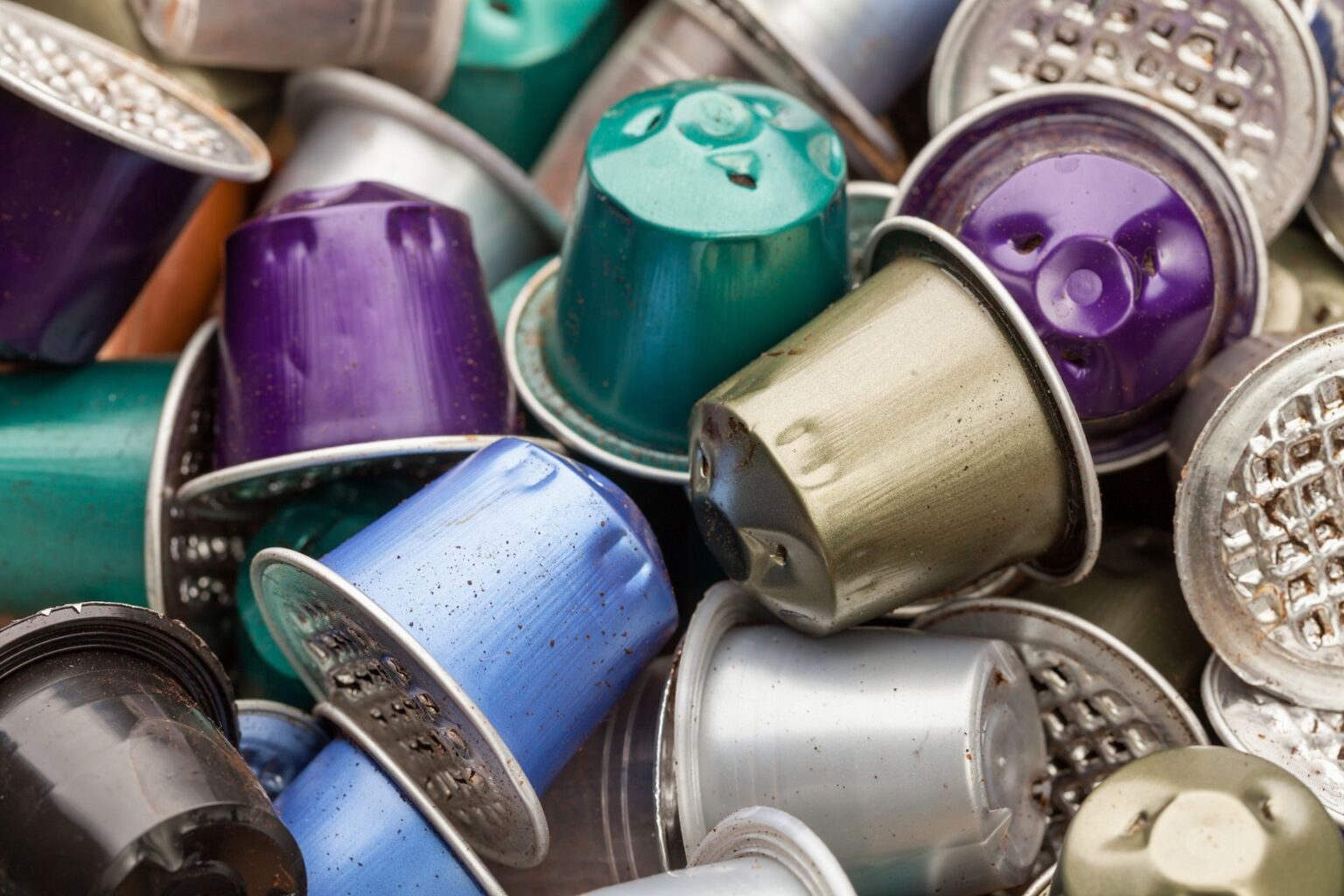
Compostable pods come with a different catch. The BPI industrial certification means a pod has been tested to disintegrate within 12 weeks and biodegrade to a 90 percent threshold within 180 days in a commercial composting facility, which runs far hotter and wetter than any backyard pile. San Francisco Bay Coffee makes that clear in its own compostable FAQ: if there’s no commercial composter nearby, the pods go in the garbage.
And for most people there isn’t one nearby. BioCycle’s 2023 survey, reported by Packaging Dive, counted about 200 full-scale food-waste composting facilities across the U.S., with nearly a third in California, New York, and Colorado. The same survey estimated that only about 4 percent of US food waste gets composted.
Compostable pods are the best choice when there’s a commercial composting service that takes them. Without one, they go to landfill like any other pod.
Aluminum is the third route. Nespresso’s capsules are aluminum, which can be recycled repeatedly without losing quality, and the company says its Original capsules are 80 percent recycled aluminum. The catch is collection.
Outside a few places with curbside programs, used capsules go back through Nespresso’s own program: a prepaid mail-back bag, a boutique, or a retail drop-off partner. Capsules that go in an ordinary household bin instead are unlikely to be sorted out and recycled.
Plastic-free, strictly speaking, means one thing for the Keurig you already own: a refillable pod you fill yourself. Everything else on the shelf has some plastic, including compostable pods, since they use plant-based plastics to hold their shape. Keurig’s new Alta brewer uses plastic-free, compostable rounds that the company says are certified for home and commercial composting, but they only work in the Alta, so existing machines still need refillable pods.
Also read 4 Healthy Teas That Can Help Boost Your Mood
The honest categories
The choice isn’t good pods versus bad pods. It’s which trade-off you can live with.
Compostable pods make sense if you have access to industrial composting. Check before you buy.
Recyclable pods make sense if your municipality takes #5 plastic and you’ll empty and rinse them. Many towns don’t, and many people won’t, so check your local rules.
Reusable pods are the only plastic-free option for the machine you already own. They also put you in charge of the coffee, so you can choose it yourself.
Five picks, one per trade-off
1. San Francisco Bay Organic Rainforest Blend OneCup: the compostable pick
SF Bay’s OneCup pods are certified commercially compostable, made from cellulose and plant-based materials, and the Organic Rainforest Blend inside them is USDA Organic. It’s a medium-dark roast from Central American beans, sold in packs from 12 to 120, and it fits most K-Cup brewers. SF Bay is unusually honest about the limits. Its FAQ says the pods aren’t home compostable and belong in the trash unless you have a commercial facility.
The limit is the composting advantage itself, which you can only use if you have somewhere to compost. If you want more than one organic option, SF Bay’s sister brand, Organic Coffee Co., sells four more in the same pod.
2. Cameron’s Organic EcoPods: the grocery-store compostable pick
Cameron’s sells certified organic Arabica in EcoPods made from plant-based materials, and they’re widely stocked in supermarkets. The Organic Breakfast Blend is a light roast from Latin American beans. Cameron’s site says the pods are certified for industrial composting, that it has composted them at home with success, and that it’s pursuing home-compost certification. Some retailer listings show a TÜV Austria home-compost mark on the box, so check the box you’re buying. If the mark is there, this is the compostable pick that doesn’t depend on a commercial facility.
However, the origin is given only as “Latin American,” and the website names neither the organic certifier nor the compostability certifier.
3. A refillable stainless steel pod: the plastic-free pick
A stainless steel refillable pod fits most Keurig machines, though some newer models only take Keurig’s own reusable filter, so check yours. It holds whatever ground coffee you put in it and is dishwasher-safe. There’s no brand to recommend because the pod is only a container. The decision is what you fill it with, and this is the one option on the list where you can use any organic coffee you already trust, ground that morning.
You give up the sealed, pre-measured convenience that made a pod machine appealing in the first place because you grind, fill, and rinse the pod yourself each time. Pre-ground coffee left in an open container stales fast, so grind as you go.
4. Purity Coffee: the pick for what’s inside the pod
The pods above were chosen for how they’re made. This one was chosen for what’s in it, and it’s the only one here that publishes lab results for the coffee itself.
Purity’s pods hold the same five blends the company sells as whole bean: FLOW medium roast, EASE dark, PROTECT light-medium, CALM decaf, and BALANCE, which is two-thirds decaf. All of it is organic, 100% Arabica, and screened by an independent lab before it’s packed.
The decafs use the Mountain Water process, which removes caffeine with water instead of chemical solvents, and the roasts are set to retain chlorogenic acids, the compounds behind most of coffee’s antioxidant claims.
Purity roasts its pods to order rather than packing them months ahead, so what arrives hasn’t been sitting on a shelf. The company is also a certified B Corp, meaning an independent body has audited how it treats workers, suppliers, and the environment.
If you own a Keurig and want pods filled with Purity’s organic coffee, they’re made of recyclable, BPA-free #5 plastic and fit most Keurig and K-Cup-compatible brewers.
These pods are recyclable plastic rather than compostable, and whether you can recycle them curbside depends on whether your town accepts #5 plastic. Keurig also runs a paid mail-back program, though it only says it takes Keurig’s own pods, so check whether Purity’s qualify before you rely on it. You’re paying for the coffee quality, not the container.
5. Nespresso Original aluminum capsules: the closed-loop pick
Nespresso’s capsules are the most recyclable pod material on this list, and the company runs its own collection program to get them back. Original capsules are 80 percent recycled aluminum, and since aluminum recycles without degrading, a returned capsule can become a capsule again.
They don’t fit Keurig machines, so this is a different purchase. Recycling only happens if you send the capsules back through the prepaid mailer, a boutique, or a drop-off partner, unless you live in one of the few places with a curbside program. In an ordinary household bin they’re small aluminum cups with coffee in them, and most facilities won’t pick them out.
Read More: The Caffeine-Free Coffee Alternative That’s Turning Heads
What to check on any pod box
Whichever way you go, five things separate a pod you’ll be glad you bought from one you’ll finish because you paid for it.
Organic certification on the coffee itself. A green leaf printed on the pod isn’t a certification, and a compostable pod tells you nothing about what was sprayed on the beans.
Who certified the compostability, and for what. BPI is the main certifier in North America. It has a commercial mark and a newer combined commercial-and-home mark, so look at which one is on the box. “Biodegradable” with no certifier behind it means nothing.
Whether your town takes #5 plastic, the number in the recycling triangle on the pod. One look at your municipality’s recycling page will tell you.
A roast date, or a roaster who says the pods are roasted to order. Pods sit on shelves for months, and ground coffee in a pod stales faster than whole bean in a bag.
Whether the decaf method is named. A roaster who won’t say is usually using the cheapest one.

Which pod to buy
Pod packaging tells you what happens after you brew. It tells you very little about what you’ll taste.
If you have access to commercial composting, SF Bay and Cameron’s both make an organic pod that belongs there. If you want to avoid plastic altogether, a steel, refillable pod filled with your own beans is the only way.
If you own a Nespresso machine and will send the capsules back, Nespresso’s aluminum program is the most complete recycling option on this list. If you own a Keurig and care most about the coffee itself, Purity’s pods are the only ones with independent screening; in a #5 plastic pod, you can recycle wherever your town accepts it.
