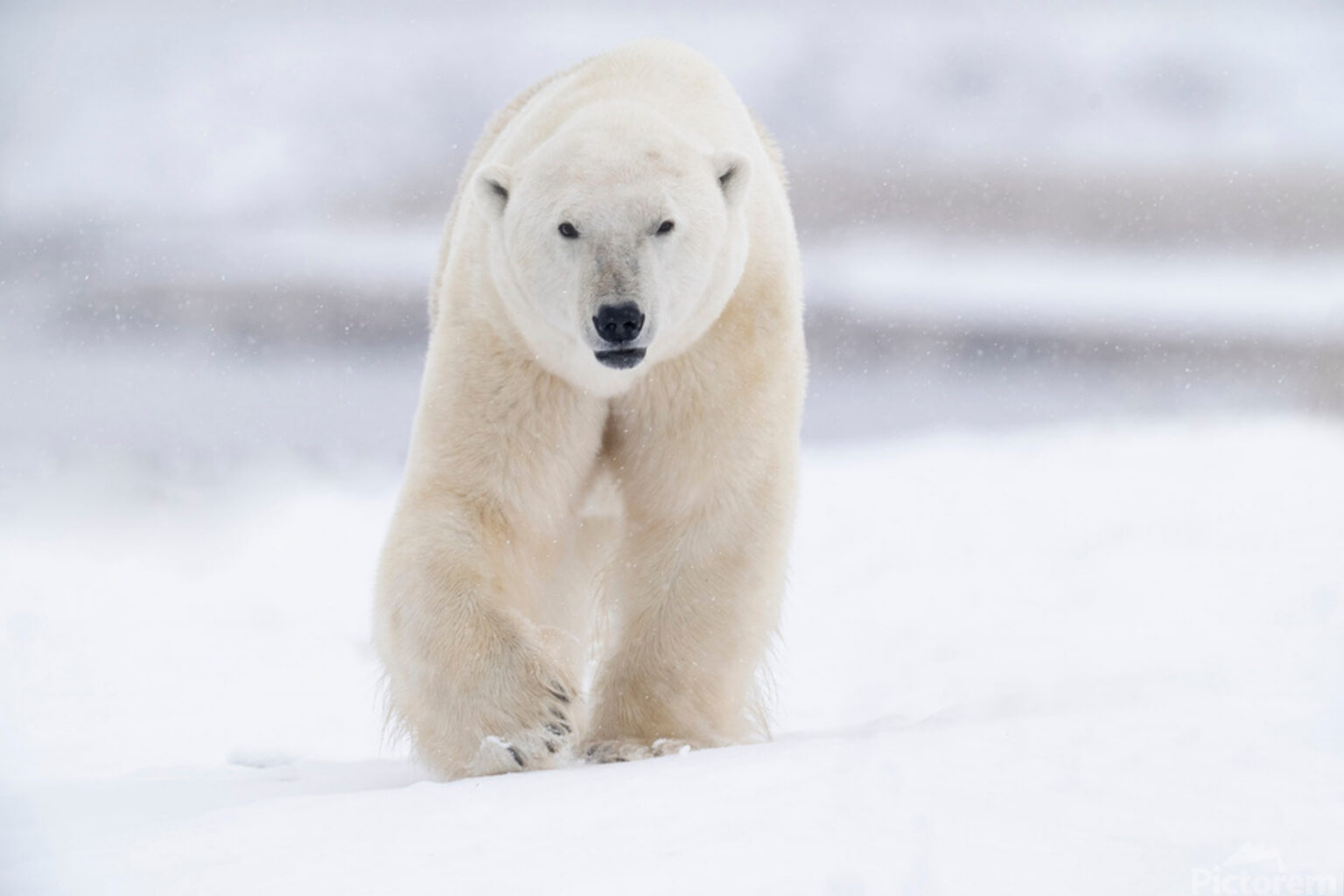
After decades spent capturing breaking news and major sporting events, a photojournalist found a different sense of time among Churchill’s polar bears.
By Johnny Hayward
My first trip to Churchill, Manitoba, was in 1999.
I didn’t know then that I would keep coming back for more than 25 years, or that the place would eventually become such an important part of my life.
At the time, photography was already taking me into some intense environments. I would go on to spend 28 years as a national staff photographer with The Canadian Press, covering Olympic Games, major sporting events, and some of the biggest news stories in Canada.
That work taught me how to react quickly.
Churchill taught me something completely different: how to slow down.
Learning to Wait
There is no rushing a polar bear.
You can spend hours in the field and see nothing. Then, without warning, a bear appears and everything changes. The animal moves, the light shifts, and you have a few seconds to react before the moment is gone.
But the important part often happens before you ever lift the camera.
You have to watch. You have to learn to recognize what is happening around you and be ready without constantly trying to force something to happen.
After years of working in news photography, where everything can move at a frantic pace, I found something incredibly grounding about that. Churchill became a place where I could simply observe.
Photography has taught me that the photograph itself is only a small part of the process. Preparation matters.
In Churchill, that means being ready for changing weather, knowing your equipment, having the right clothing, and understanding that the day may not unfold according to plan.
It also means knowing when not to take the photograph.
Wildlife doesn’t perform for the camera. A polar bear doesn’t care about the image you have in your head. The longer I spent photographing animals, the more I came to appreciate that.

Some of the best photographs happen when you stop trying to manufacture the moment and simply pay attention to what is actually unfolding in front of you.
For years, Churchill was something I did for myself. Eventually, it became the next chapter of my career.
I launched Bear Witness Photo to create small-group photography experiences in Churchill, built around the way I had learned to experience the area. We keep the groups intentionally small, with a maximum of three guests per vehicle. There is space for camera equipment, and each guest has their own door and window.
Those details matter when photography is the reason you have travelled all that way. But the bigger part of what I try to share with guests isn’t simply how to operate a camera.
It is how to look.
My years as a photojournalist taught me to anticipate moments. Wildlife photography uses that same skill, but with a very different sense of time.
Instead of waiting for something to happen and immediately reacting, you learn to notice the small clues beforehand. Where is the animal looking? What is its behaviour telling you? What is happening with the light? Is this actually the moment to make the photograph, or is there something better coming?
Sometimes, the answer is to wait.
The Photograph Is Secondary
The longer I photograph wildlife, the more important this has become for me: getting a photograph cannot be the only objective.
The animal comes first.
That means observing wildlife without trying to force an interaction. It means understanding that being close enough to photograph something does not automatically mean you should move closer.
The privilege is being allowed to witness these animals in their environment. The photograph is secondary.
After more than 25 years, Churchill still gives me something I find difficult to explain to people who haven’t experienced it.
My professional life was built around movement: assignments, airports, deadlines, sporting events, and breaking news. There was always another place to get to and another moment to capture.
Churchill doesn’t work that way. It makes you slow down and pay attention. Somewhere along the way, I realized that was exactly what I needed.
I originally went north because I wanted to photograph polar bears. I kept returning because of what the place was teaching me.
The North has a way of stripping things back. You notice the weather, the landscape, the silence, the animal in front of you, and the person sitting beside you.
You stop worrying quite so much about the photograph you came to make and start paying attention to the experience you are actually having.
That’s something photography has always been able to do for me. It gives me a reason to stop and look.
Churchill simply taught me how important that can be.

Johnny Hayward is an award-winning Canadian photojournalist and founder of Bear Witness Photo. He spent 28 years as a national staff photographer with The Canadian Press, covering major sporting events, the Olympic Games and national news across Canada and internationally.
His first trip to Churchill was in 1999, and he now leads small-group polar bear photography experiences in the region.